
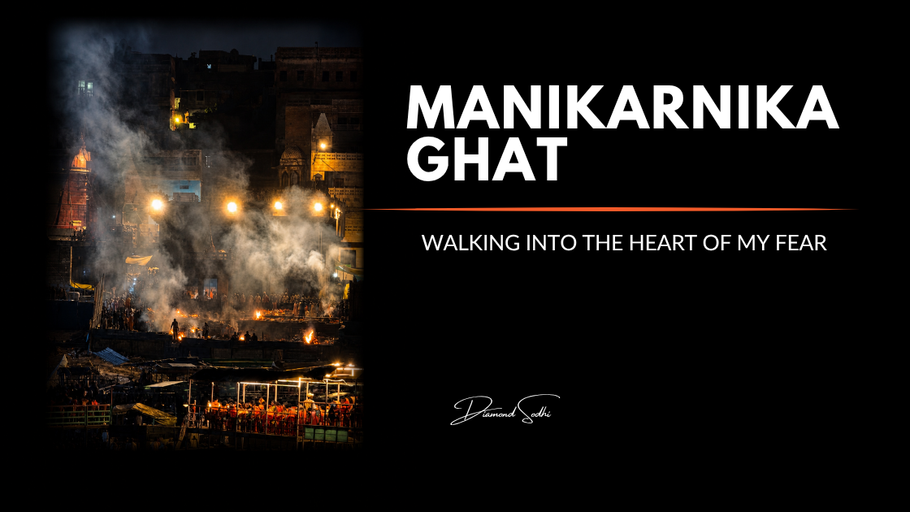
Manikarnika Ghat: Walking into the Heart of My Fear
Many of my travel inspirations emerge from offbeat films that linger in my mind long after the closing credits.
After watching Dhak Dhak, I found myself embarking on one of the most challenging road journeys of my life—to Umling La, regarded as one of the highest motorable roads in the world. Khardung La, once celebrated for holding that distinction, continues to be treated as a kind of Mecca for motorcyclists. And after hearing about Hanle, with its clear night skies and astronomical observatory, I knew I had to stand beneath its Milky Way at least once.
Cinema has often taken me to places that conventional travel brochures never could.
About three years ago, I attempted to watch Mukti Bhavan. I have always had an unpredictable attraction to parallel and offbeat cinema. Even I cannot fully define the genre that appeals to me. At times, my own choices surprise me.
During my first attempt, I could not sit through the film. I found it slow, perhaps even boring. A month ago, however, I gave it another chance and watched it until the end.
This time, it left me in tears.
Perhaps it was the idea of the Mukti Bhavans—the so-called death hotels of Kashi—where people believed to be approaching the end of their lives come to spend their final days. They wait there for the body to surrender and, according to Hindu belief, for the soul to attain moksha.
The thought was disturbing, fascinating and impossible to dismiss.
And at the centre of that thought stood Manikarnika Ghat.
The Place I Had Imagined
For years, I had heard about Manikarnika Ghat without even knowing exactly where it was. My geographical compass has always betrayed me.
In my imagination, it was something like an enormous fort converted into a multistoreyed cremation complex—a vast, terrifying structure where bodies arrived continuously and disappeared into flames.
The reality is different.
Manikarnika Ghat is one of Varanasi’s principal cremation grounds, located on the banks of the Ganga near the Kashi Vishwanath Temple. It is not a fort or a conventional crematorium. It is an ancient riverfront landscape of stone steps, temples, platforms, buildings, stacked firewood and open-air funeral pyres.
Cremations take place throughout the day and night.
In Hindu belief, dying or being cremated in Kashi can bring liberation from the cycle of birth and rebirth. Families therefore bring their deceased relatives from across India to Manikarnika Ghat for their final rites.
But perhaps my attraction to Manikarnika was not entirely spiritual.
Perhaps I wanted to go because I was afraid.
I had always carried an enormous fear of dead bodies being taken for cremation. The sight of four men carrying a shrouded body on their shoulders would unsettle me deeply. Maybe my decision to visit Manikarnika was an attempt to walk directly into the centre of that fear and discover what, exactly, lived there.
Varanasi, Banaras and Kashi
One of the first things I understood during the journey was that Kashi, Banaras and Varanasi are different names for the same city.
Yet, in my mind, they evoke entirely different emotions.
Varanasi feels connected to infrastructure, development, corridors, hotels and tourists.
Banaras feels like the spirit of the city—fearless, witty and gloriously unconcerned with appearances. It embraces strangers and sometimes turns the briefest association into a lifelong bond.
Kashi, to me, represents the darker and more sacred dimension of the same place. It is the world of the Kaal Bhairav Temple, revered and feared; the Kashi Vishwanath Temple, considered an essential pilgrimage; and Manikarnika Ghat, the ancient seat of fire, death and moksha.
It was this Kashi that frightened me.
And it was this Kashi that I wanted to understand.
A Warning Before the Journey
Our cab driver, a Muslim man familiar with the city, warned us that the energy around Manikarnika Ghat was intensely heavy.
He told us that the smell of the cremations would make it difficult to remain there for more than a few minutes. Even while passing the ghat by boat, he said, the air could become difficult to breathe.
He advised us not to go beyond the area where the pyres were visible.
“What is there to see beyond that?” he asked.
At the time, I did not fully understand his question.
Later, I did.
Travelling Towards What Frightened Me
I had planned the journey as a solo trip, though not without apprehension.
It was not because I had never travelled alone. I had travelled across half the world at nearly half my present age. But travelling alone to Uttar Pradesh—and to a city containing the contrasting shades of Varanasi, Banaras and Kashi—felt strangely unsettling.
I initially considered staying at an IHCL property situated close to the Kashi Vishwanath Temple and Manikarnika Ghat. Eventually, I chose the Taj because it was farther away from the ghats.
I wanted to visit Manikarnika, but I did not want to sleep beside it.
The trade-off between staying close to the Ganga and being surrounded by the imagined energy of the cremation ground did not appeal to me.
We reached the area near the Kashi Vishwanath Temple after walking nearly a kilometre, as four-wheelers could only travel up to a certain point. It was extremely hot, and my legs were too tired to stand in the long queue for darshan.
In any case, visiting the temple had not been central to my plan. I intended only to pay my respects from outside.
Near the entrance, a small shop selling flowers, prasad and puja items had attracted a modest crowd. A few pandits were sitting nearby. I approached one of them and asked whether he could guide me to Manikarnika Ghat.
He insisted that I should first visit the Kashi Vishwanath Temple and offered to help me skip the queue.
I told him, almost stubbornly, that I had travelled all the way from Punjab specifically to visit Manikarnika Ghat.
One of the pandits finally agreed to walk me there.
It was unexpectedly kind of him.
Through the Lanes of Banaras
Panditji walked so quickly that following him felt like trailing behind an advancing army troop.
As we moved through the lanes, he pointed out local shops and landmarks, including the famous Blue Lassi shop. When he stopped and asked whether I wanted to try one, I politely declined.
We were approaching a mass cremation ground. The thought of enjoying lassi or any other food at that moment did not sit well with me.
Soon, a small sign on a wall pointed towards Manikarnika Ghat. The road branched into even narrower lanes. A cow wandered lazily through the passage as if taking an afternoon stroll.
I asked Panditji whether bodies carried on the shoulders of four men passed through these same narrow lanes.
He confirmed that they did. These lanes were the only route to the cremation ground.
He added casually that another body would probably appear behind us at any moment.
Life continued around us with astonishing normalcy.
Every fourth shop seemed to be stacked with wooden logs meant for the cremation fires, an unsettling reminder that death was not hidden from daily life in Banaras but woven directly into its commerce, rhythm and routine.
The lanes sold Banarasi saris, khoya, paan and lassi. People stood eating kachori and jalebi. Nearby were the Mukti Bhavans—the death hotels in which people came to wait for their final breath.
The proximity of food, commerce, religion and death was bewildering.
Banaras appeared to be a cultural melting pot of Brahmins and Muslims, bound together by a shared identity: Banaraswale.
The wit of the city appeared even on the walls. Outside a hakim’s shop, a sentence read:
Mere angane mein tumhara kya kaam hai? Yahan faltu logon ka baithna mana hai.
That was Banaras—irreverent, direct and completely itself.
The First Sight of Manikarnika
After walking another few hundred metres, I saw an arrow painted on a wall:
Way to Manikarnika Ghat.
We turned right.
The lane narrowed further, and a flight of stairs began descending towards the level of the Ganga.
Then Manikarnika came into view.
I saw approximately six burning pyres and another body waiting for cremation. The bodies were wrapped in white cloth, with saffron-orange fabric placed over them and marigold garlands resting on top.
The ghat looked nothing like the monumental cremation fortress I had imagined.
Instead, it appeared to be a relatively compact, partially enclosed cremation area. Temporary blue metal sheets stood along the sides. New construction seemed to be closing in around it, restricting the cremation space to a smaller parcel of land.
I found myself staring at one of the pyres.
For a moment, I could distinguish the shape of the skull within the flames.
Yet the most unsettling part was not the sight.
It was the ordinariness.
Everything appeared to be business as usual.
A few relatives and acquaintances stood nearby. There was no dramatic heaviness, no overwhelming darkness and no visible display of grief. I heard no loud prayers. I saw no one wailing. The place was littered with rubbish.
It seemed less like the sacred gateway to moksha that I had constructed in my mind and more like a working cremation ground completing its daily function.
I struggled to reconcile the reality before me with the mythology surrounding it.
Was this truly the place to which the remains of some of the wealthiest and most influential Hindus were flown for the ultimate cremation?
Was this the sacred fire said to liberate the soul?
Or was it simply another place where the living completed their duties towards the dead?
I asked Panditji whether we could move further ahead, closer to the riverbank.
He looked at me and repeated almost exactly what the cab driver had said.
“Why? What is the point?”
He was right.
We turned back.
Seeing It Again from the Ganga
That evening, I had booked a two-hour cruise beginning from Ravidas Ghat and travelling past the celebrated ghats of Varanasi.
The upper wooden deck felt almost luxurious. A mild drizzle fell from the sky. A light breeze travelled across the river. Comfortable sofas overlooked the ghats on one side and the vast Ganga on the other.
There was Banarasi food, continental snacks, fresh watermelon juice and a delightful cup of tea.
For a while, the city felt serene.
The cruise paused at two places. The first was near the evening Ganga Aarti. The second was in front of Manikarnika Ghat.
Because the cruise was a large vessel, it remained farther from the ghats than the smaller steamers and wooden boats. From that distance, the cremation ground seemed almost miniature.
I zoomed in with my camera. I could count the people standing there, let alone the bodies being cremated.
And then the smoke reached us.
The cab driver’s warning returned to me.
The thick fumes travelled across the water and reached the deck. My stomach turned. It was not the mystical heaviness of energy that disturbed me.
It was something physical.
It felt as though the smoke from burning skin, bones and muscle had entered the air around me and settled into the pores of my own body.
Something about it felt invasive.
Something did not feel right.
The Smell That Travelled Home
When I returned to the hotel, I wanted nothing more than to take a shower.
It had been a long and exhausting day. I had no appetite for dinner. I ordered a milkshake and slept deeply.
The next morning, before leaving for my flight to Delhi, I decided to blow-dry my hair so that I would look slightly fresher.
The moment warm air passed through it, a nauseating smell rose from my hair.
I turned off the dryer immediately.
My hair had never smelt like that.
Never.
The smell remained with me throughout my journey.
After landing in Delhi, I had a day packed with chores and a dinner with my cousin and my younger son, who now practises in the city. I had no time to visit a salon.
That night, after turning off the lights, I pulled a thick strand of hair towards my face.
The smell was still there.
It was difficult to describe, yet impossible to ignore. I wanted it removed immediately.
By the time I reached Jalandhar the following afternoon, urgent work was waiting at my desk. Still, I booked an immediate appointment for a hair wash.
For the first time, my hairstylist asked whether he could wash my hair twice.
I understood why.
After the double wash, conditioning and blow-dry, I finally felt lighter. My hair felt like my own again.
But at 2:47 a.m. that night, I woke up shivering with a temperature of 102 degrees. I took paracetamol, but the following day I was too weak and feverish to go to work.
For the first time, I missed three consecutive days at the office because of illness.
My body felt feeble, exhausted and painfully unwell. It did not feel like an ordinary viral fever. I cannot say what caused it, nor can I scientifically connect it to the journey, but it took nearly ten days before I felt that my body had released whatever seemed to be pulling it down.
Did Kashi Reject Me?
Kashi did not seem to accept me.
Or perhaps I was the one resisting what it forced me to confront.
For several days, I wondered whether I should ever have gone.
Maybe I should not have.
Or perhaps I had to go and see for myself that the experience so often presented as spiritually uplifting—the air of Shiva, the promise of moksha, the confrontation with mortality and the invitation to self-reflection—was not something I needed to travel to Kashi to discover.
The awareness of death had already lived within me for years.
There is a popular belief that a visit to Kashi makes one understand that life is temporary and death is permanent.
But I have always known that.
I wake every morning and sleep every night with the same clear understanding:
Death is moving closer to me with each passing day. Its arrival is certain.
What remains uncertain is how many more days I will be given to live.
Perhaps Manikarnika did not teach me about death.
Perhaps it forced me to ask a far more difficult question:
While death is certain, am I living the uncertain days with enough courage, and freedom?