
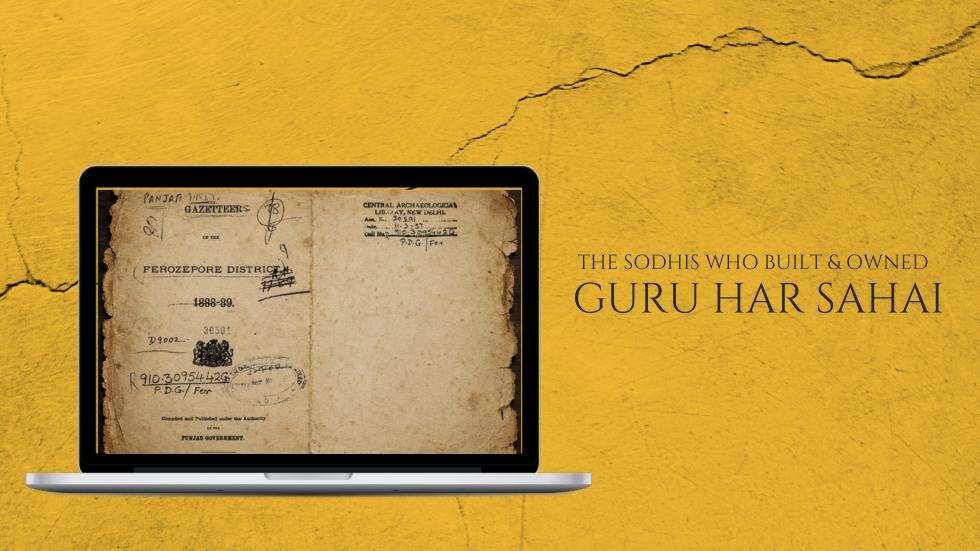
The Sodhis Who Built And Owned Guru Har Sahai
Guru Har Sahai: Where Exile Became Inheritance
Some places are born through conquest, commerce or imperial design. Others emerge from something far more fragile: displacement.
Guru Har Sahai belongs to that rarer category. Its story begins in exile, but evolves into one of resilience, spiritual authority and enduring inheritance.
In the mid-eighteenth century, Punjab was passing through profound political upheaval. The region that would eventually become Guru Har Sahai was then a largely desolate tract, lying between territories influenced by the Barars and Dogars, whose competing claims frequently led to conflict.
Into this unsettled landscape came Guru Jiwan Mal Sodhi, a descendant of Guru Ram Das Ji.
According to the Punjab District Gazetteer, Guru Jiwan Mal arrived around 1745, after being compelled to leave his ancestral home at Mohammadpur, near Chunian in the Lahore district, now in Pakistan. His displacement arose amid political hostility under the local administration associated with Ahmad Shah’s authority.
To leave ancestral land in eighteenth-century Punjab was far more than a change of residence. It meant separation from inherited soil, familiar relationships, social position, ancestral memory and the landscape within which generations had defined themselves.
Yet exile does not always extinguish legacy.
Sometimes, it redirects it.
Guru Jiwan Mal entered an unfamiliar, disputed region and pitched his tent upon barren ground. That simple act would become the symbolic beginning of Guru Har Sahai.
A Spiritual Presence in a Contested Land
The territory into which Guru Jiwan Mal arrived was politically unstable. The Barars and Dogars continued to contest influence over the area, and neither side had achieved lasting dominance.
His arrival changed the equation.
The Dogar Chief Sultan offered him protection and encouraged him to remain. The presence of a respected religious figure, unaligned with either faction, offered the possibility of stability where political rivalry had repeatedly failed.
The Barars, too, accepted him.
As a Sodhi descendant of Guru Ram Das Ji, Guru Jiwan Mal possessed a spiritual legitimacy that transcended ordinary territorial politics. He represented a lineage and moral authority larger than either faction.
A displaced man had entered a disputed land and, paradoxically, become a source of equilibrium.
The territory was not conquered.
It was entrusted.
The Morning an Estate Was Drawn
One of the most evocative traditions preserved in the Gazetteer concerns the manner in which Guru Jiwan Mal established the extent of his estate.
Having received consent to establish villages across the plain, he is said to have mounted his horse one morning and ridden around the expanse of land he intended to settle.
The tracks left by his horse became the markers of the territory.
The image has an almost mythic simplicity: a solitary rider crossing open Punjab earth, leaving behind hoofprints that would gradually become the perimeter of a future estate.
There were no elaborate surveys or ceremonial declarations of possession. Yet that journey acquired permanence.
The land enclosed within that circuit developed into an illaqa that survived changes of rulers, empires and political systems.
Guru Jiwan Mal named the domain after his eldest son:
Har Sahai.
Har Sahai would later succeed him as head of the family. The honorific “Guru”, associated with the hereditary Gaddi and its custodial tradition, became inseparable from the name of the settlement.
Thus emerged:
Guru Har Sahai.
Nearly three centuries later, the name endures.
From Exile to Recognition
Guru Jiwan Mal’s political circumstances eventually changed. Historical accounts indicate that he later reached an accommodation with Ahmad Shah’s administration and was permitted to hold his land free of revenue.
In eighteenth-century Punjab, such an exemption represented far more than financial privilege. Revenue rights were closely linked to political authority; exemption therefore signified recognition, influence and status.
When Muslim authority declined and Maharaja Ranjit Singh became the dominant power in Punjab, the grant was renewed.
The regime changed.
The recognition endured.
The Sodhi estate therefore survived remarkable political transitions: Afghan authority, the Sikh Empire, British colonial rule and eventually independent India.
By the nineteenth century, members of the Guru Har Sahai Sodhi family had also entered the formal record of Punjab’s landed and aristocratic society. Sir Lepel H. Griffin, in The Punjab Chiefs, documented prominent families of the province, including figures associated with Guru Har Sahai such as Guru Bishan Singh and later Guru Jaswant Singh.
The family thus occupied an unusual position: rooted simultaneously in sacred genealogy, territorial history and the political architecture of historical Punjab.
Yet land and status tell only part of the story.
The more enduring question concerns moral authority and historical provenance.
Who Truly Commands Guru Har Sahai’s Moral Authority?
In modern times, political figures periodically proclaim that “Guru Har Sahai belongs to us”
One politically ambitious family, whose rise began with a relatively modest foothold in municipal politics, over time converted political proximity, influence, and commercial opportunity into considerable wealth. What is striking, however, is the subtle attempt to recast that acquired prominence as inherited lordship—particularly before a younger generation increasingly detached from the very history of how Guru Har Sahai came by its name. Local memory tells a less embellished story. The family’s grandfather’s earlier association with the town is remembered through Jaggu Churianwala, the bangle seller who was summoned to the Sodhi fort with his finest glass bangles for the women of the household. There is no indignity in humble beginnings, nor in prosperity earned across generations. But wealth cannot manufacture ancestry.
Long before constituencies, election campaigns or political dynasties, there stood the Sodhi family.
Guru Har Sahai was not named by politicians, administrators or elected representatives.
Its identity predates them all.
The settlement arose from the arrival of Guru Jiwan Mal Sodhi, a descendant of Guru Ram Das Ji. The estate was established under his authority, named after his eldest son Har Sahai, and carried forward through the hereditary Guru Gaddi.
Political power changes hands. Governments rise and fall. Elections are won and lost. Fortunes are created and disappear.
Provenance does not change with political convenience.
So when the question is asked, “Whom does Guru Har Sahai truly belong to?”, history offers an answer considerably older than contemporary politics.
Its origins, its name and its historical identity remain inseparably intertwined with the Sodhi lineage, the Guru Gaddi and the family whose exile transformed a contested tract of Punjab into the estate that came to be known as Guru Har Sahai.
What began as displacement became settlement.
What began with a tent became an estate.
And what began as exile became inheritance.