
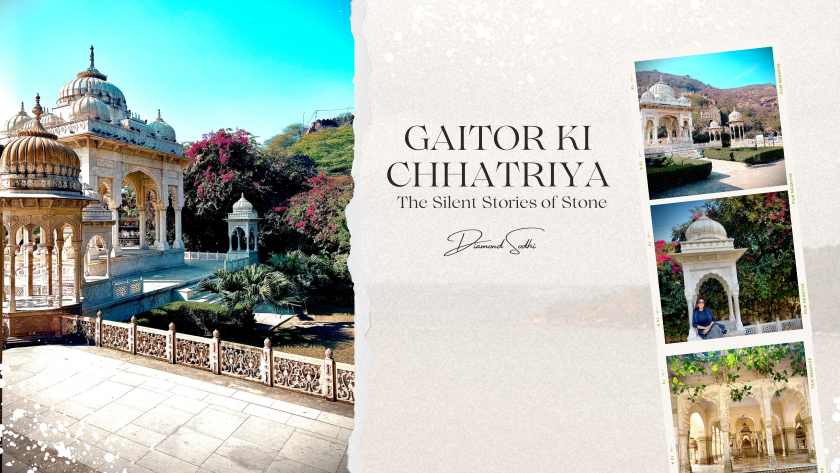
Gaitor Ki Chhatriyan, Jaipur: The Silent Stories of Stone
I stumbled upon Gaitor Ki Chhatriyan while planning my itinerary during the Jaipur Literature Festival 2026. Amid panels, readings, and cultural chaos, I found myself craving a pocket of quiet—a space untouched by festival footfall. That’s when Gaitor appeared on my radar, almost like a whisper from the past.
The moment I typed “Gaitor Ki Chhatriyan” into Google, something curious happened—almost everything switched over to Hindi-based results. It’s as if this place, like the Rajput kings it shelters, has chosen to whisper only in the native tongue. And perhaps that’s fitting. Because Gaitor isn’t the kind of tourist spot that shouts for attention. It doesn’t try to sell itself with glossy gimmicks or curated spectacles. Instead, it waits—quiet, solemn, forgotten in parts—cloaked in history and silence, for the kind of visitor who seeks more than just photographs.
Naturally, tourist reviews are predictably unkind: “Nothing to do here,” they say. “Empty. Boring. Skippable.” But for me, that’s the very allure. A place unapproved by the guidebooks, free from souvenir peddlers and camera-crazed crowds? That sounds like a sanctuary—my kind of place.
Getting there is a modest affair. A narrow road slinks through the chaos of urban Jaipur, flanked by cluttered shops and day-worn buildings, before ending at a simple gate. An old guard sits at his post, barely lifting his gaze. There’s no fanfare, no booming announcements of grandeur. His lack of enthusiasm seems borrowed from the melancholy air the place exudes. But cross the gate, and the world shifts.
The chirping of pigeons rises gently, a welcome intrusion into the near-total silence. Their wings flutter against the stillness, circling the domed chhatris—cenotaphs—standing like sentinels of memory. These pavilions, mostly octagonal or square, are etched with floral motifs, delicate lattice work, and carvings that speak of both glory and grief. Looming trees cast fragmented shadows, while the Aravalli Hills frame the site like a natural shroud.
A Royal Ground of Ashes and Marble
Gaitor Ki Chhatriyan lies at the foothills of the Nahargarh Fort and serves as the royal cremation ground of the Kachwaha Rajput dynasty. This dynasty ruled Jaipur, and their final rites have been performed here since the early 18th century. In 1733, Maharaja Sawai Jai Singh II, the visionary founder of Jaipur, chose this site as the official cremation ground for his royal line.
The name “Gaitor” is said to be a mispronunciation of Gaye ka Thor—translated roughly as the resting place of the departed. That understated meaning wraps itself around the entire complex. Each chhatri stands over the ashes of a ruler, and in its arches and domes, tells a silent tale—of battles won, territories ruled, temples built, and empires defended.
Chhatris That Speak in Silence
No two chhatris are alike. The cenotaph of Maharaja Sawai Jai Singh II, for instance, is a masterpiece—white marble adorned with intricate carvings, its every line etched with the pride of a ruler who imagined a city in pink stone. Others, more subdued, wear the erosion of time, their edges softened by wind and neglect. But each one—grand or modest—holds a story within.
These are not merely tombs. They are narratives carved into marble. A Rajput king’s honour, courage, patronage, or even sorrow, given shape in architecture. The silence of Gaitor is not emptiness. It is reverence.
Why Gaitor Matters
In a city like Jaipur, dazzling with colors, bustling bazaars, and royal palaces, Gaitor feels like the unspoken chapter. It doesn’t clamor for attention. It doesn’t promise entertainment. What it offers is something deeper: an untouched space to contemplate time, mortality, and legacy.
There’s a certain poetic justice that a place built for the dead feels so vividly alive in its textures and quietude. Maybe it was always meant to be this way—a retreat from the clamor of the living world, reserved only for those who care to listen to the marble.
And if you do, Gaitor Ki Chhatriyan will speak. Not loudly. But with the voice of stone, wind, and memory.